News Story
Plasma for Disinfection Study Wins DOE Grant
A new study that seeks to explain how and why plasma (a gas containing charged, reactive molecules) is so effective at deactivating toxic proteins and biomolecules could lead to its broader use in the medical community. The project, a unique blend of plasma science and bioengineering, will be the first to explore the mechanistic effects of plasma on bacteria at the monolayer level.
Clark School Professors Gottlieb Oehrlein (joint, Department of Materials Science and Engineering [MSE] and Institute for Research in Electronics and Applied Physics [IREAP]) and Joonil Seog (joint, MSE and Fischell Department of Bioengineering) have received a three-year, $330,000 grant from the Department of Energy's Office of Science for Fusion Energy Sciences for their proposal, titled "Fundamental Science of Low Temperature Plasma-Biological Material Interactions."
Plasma is commonly used in the production of electronic devices at low pressure. Plasma at room temperature and atmospheric pressure, however, is used to sterilize surgical equipment and to disinfect clothing or surfaces. Its antibacterial and antimicrobial properties also mean it can be used for wound care, a treatment that has been tested but is not widespread. Exactly why and how these treatments work, however, it not yet understood.
Conventional plasma treatment of surgical instruments and biomedical devices completely removes biomolecules, but the harsh reaction conditions may also remove surface layers from the equipment, degrading their performance. Oehrlein is developing a "gentle and selective" means of plasma application that will allow Seog, who specializes in molecular mechanics, to observe exactly which reactive plasma molecules interact with individually targeted biomolecules in a biological assay designed specifically for this research.
"If we understand exactly how plasma deactivates biomolecules we'll have many opportunities to extend and customize the technology," says Seog. "It could be used in a variety of laboratory and hospital procedures, target different kinds of toxins from bacteria or viruses, and possibly facilitate tissue regeneration. Using this technique, we may be able to deactivate toxic molecules by altering their molecular structure in a selective manner."
"Researchers have been excited by the potential advantages of plasma-based treatments over traditional disinfection methods." Oehrlein adds. "The plasma approach only requires electrical energy and simple gases, like air. Working at low temperature and atmospheric pressure means the devices used in treatment could be small, portable, and easy to operate. It may also help in cases where an infection is resistant to antibiotics."
Oehrlein and Seog will collaborate with professors Jhih Wei Chu and David Graves (Department of Chemical and Biomolecular Engineering, University of California–Berkeley), who have received a similar grant to perform complimentary experiments and model and interpret the data. The study is also funded in part by the National Science Foundation.
For More Information:
See "Redefining 'Clean'," an American Vacuum Society press release about the progress of this project »
Visit Professor Oehrlein's web site »
Visit Professor Seog's web site »
Published September 23, 2010
Related Stories
Stories / April 24, 2023
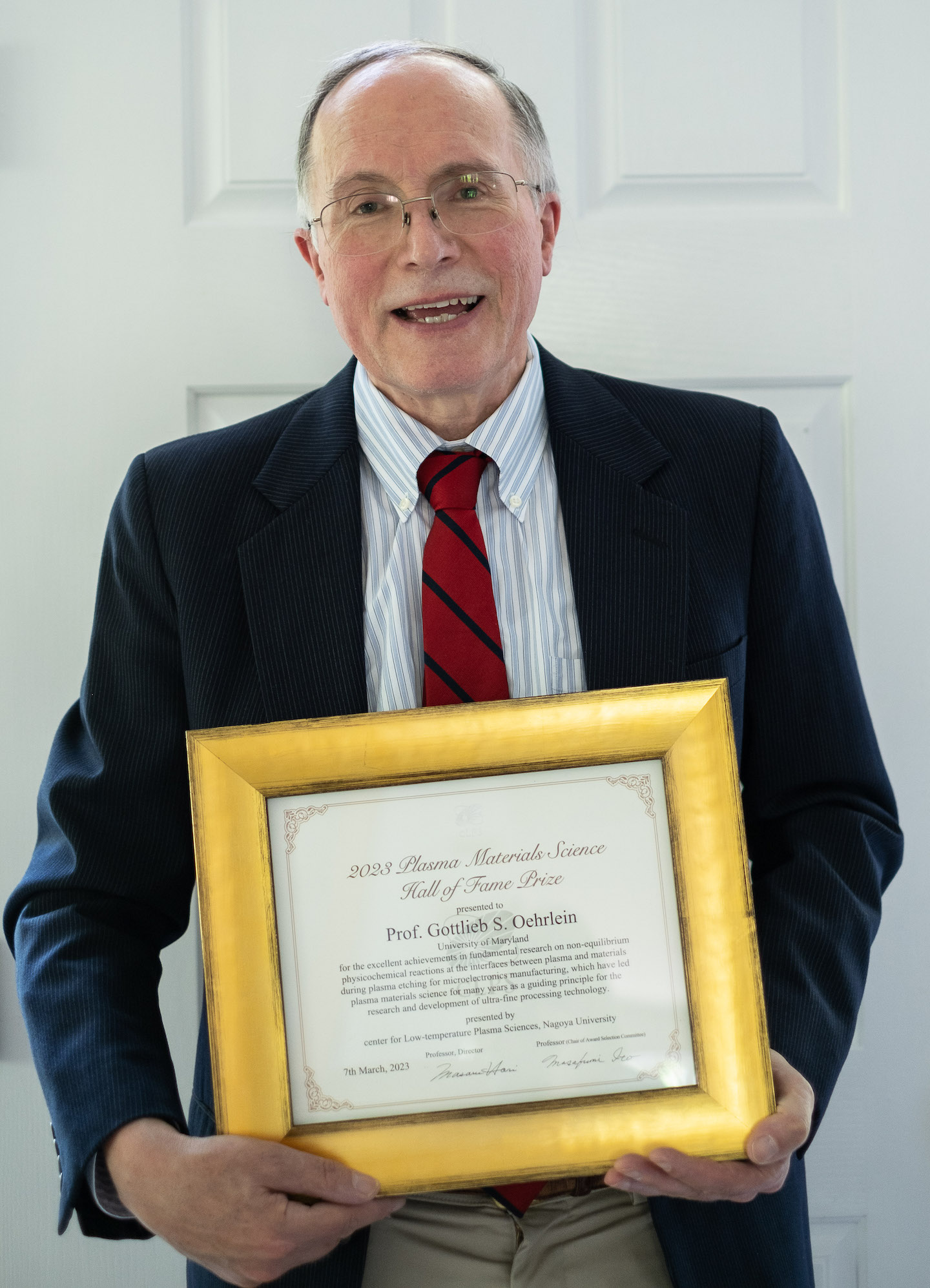
Gottlieb Oehrlein Inducted to Plasma Materials Science Hall of...
Stories / October 12, 2022
Timothy Koeth Wins DARPA Young Faculty Award
Stories / September 14, 2010
Oehrlein Receives IBM Faculty Award
Stories / February 22, 2010
Oehrlein, Arsenault Highly Cited Worldwide
Stories / December 2, 2009
Bruce Wins 2009 AVS Student Merit Award
Stories / November 3, 2009
Alumnus Publishes Book on Plasma Etching
Stories / December 19, 2007
Oehrlein Studies Plasma/Wall Interactions on Sabbatical
Stories / February 2, 2006
Oehrlein Receives 2005 Prize in Plasma Science and Technology
Stories / Oct 5, 2026
Celebrating LGBTQ+ History Month 2026

Stories / Oct 1, 2026
Kelly M. is Learning (and Advocating for Students) by Doing

Stories / Sep 23, 2026
Alchemity receives Breakthrough Energy Fellowship

Stories / Sep 22, 2026
Two Years Running, Maryland #12 Among Publics for Undergrad...

Stories / Sep 15, 2026
Honoring Achievement: Celebrating Latine Heritage Month

Stories / Sep 15, 2026
Tabatha Cuadra Rodriguez: Community Advocate

Stories / Sep 14, 2026
UMD Copper Ink Startup Receives Strategic Investment from E Ink

Stories / Sep 3, 2026
UMD Convocation will honor five from the Clark School

Stories / Aug 27, 2026
Maryland Engineering Student Organizations (MESO):...

Stories / Aug 24, 2026
Two UMD engineering professors named to Technical.ly's 2026...
