News Story
Karki Wins Best Poster, Best Oral Presentation Awards
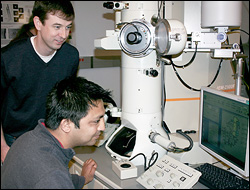
Associate Professor John Cumings (standing) and Khim Karki (seated) working with a transmission electron microscope.
NEES is one of 46 multi-institutional Energy Frontier Research Centers established by the U.S. Department of Energy in 2009. NEES members, who include 55 members from half a dozen institutions, are developing highly ordered, multifunctional nanostructures for advanced electrical energy storage.
Karki's winning poster, "Real-time investigation of engineered silicon nanostructures for lithium-ion battery electrodes," presented fundamental insights about what occurs in individual nanoscale battery components during their operation. These discoveries were made possible by the Cumings Group's signature use of in situ transmission electron microscopy (TEM), a technique which allows them to observe and characterize nanoscale devices in realtime.
"We observed fracture behavior of silicon battery electrodes even at the nanoscale," Karki explains. "To circumvent this problem, we proposed to engineer the individual nanostructured materials…[using] cross-networking of individual silicon nanowires and heterostructuring of carbon nanotubes and silicon in a core-shell structure. Both techniques have been shown to address the problem associated with the silicon instability, which otherwise has the highest lithium charge storing capacity in a battery—ten times more than the existing technology based on graphite electrode materials."
Karki's efforts to create robust nanoscale silicon electrodes are carried out in collaboration with Tom Picraux (Los Alamos National Lab), YuHuang Wang (Department of Chemistry and Biochemistry), Chunsheng Wang (Department of Chemical and Biomolecular Engineering), Teng Li (Department of Mechanical Engineering), and Yue Qi (General Motors).
NEES students and postdoctoral research associates voted Karki's oral presentation, "In-situ TEM studies of silicon nanostructures for lithium-ion battery electrodes," best in the technical session. The talk covered the Cumings Group's in situ TEM platform, its capabilities, and how it has been used in the team's research. Karki also highlighted the group's past and current efforts to understand the mechanics and kinetics of nanostructured silicon battery electrodes.
Published November 6, 2012
Related Stories
Stories / June 20, 2014
Department of Energy renews NEES EFRC for four years

Stories / December 5, 2012
Rubloff Co-Authors Major DoE Report on Emerging Energy...
Stories / March 2, 2012
Award Funds Development of Solid-State, High Power Lithium-Air...
Stories / November 8, 2012
Cornett, Karki Selected for Sustainable Energy Workshop in...

Stories / February 16, 2012
Karki Selected for Future Faculty Program
Stories / May 25, 2011
Rubloff quoted in story about DOE Energy Frontiers Research...
Stories / May 4, 2010
Rubloff Team Invention of the Year Could Revolutionize...
Stories / May 13, 2009
UMERC/Nanocenter Team Named "Energy Frontier" Center
Stories / Sep 15, 2026
Honoring Achievement: Celebrating Latine Heritage Month

Stories / Sep 15, 2026
Tabatha Cuadra Rodriguez: Community Advocate

Stories / Sep 14, 2026
UMD Copper Ink Startup Receives Strategic Investment from E Ink

Stories / Sep 3, 2026
UMD Convocation will honor five from the Clark School

Stories / Aug 27, 2026
Maryland Engineering Student Organizations (MESO):...

Stories / Aug 24, 2026
Two UMD engineering professors named to Technical.ly's 2026...

Stories / Aug 24, 2026
Researcher Accidentally Reveals Intricate Physics of Electron...

Stories / Aug 24, 2026
UMD Hosts Teachers for a Summer of Sustainable Cooling Research

Stories / Aug 12, 2026
Keeper of the Codes

Stories / Aug 10, 2026
UMD Joins NSF's $400M AI Nanofabrication Initiative
