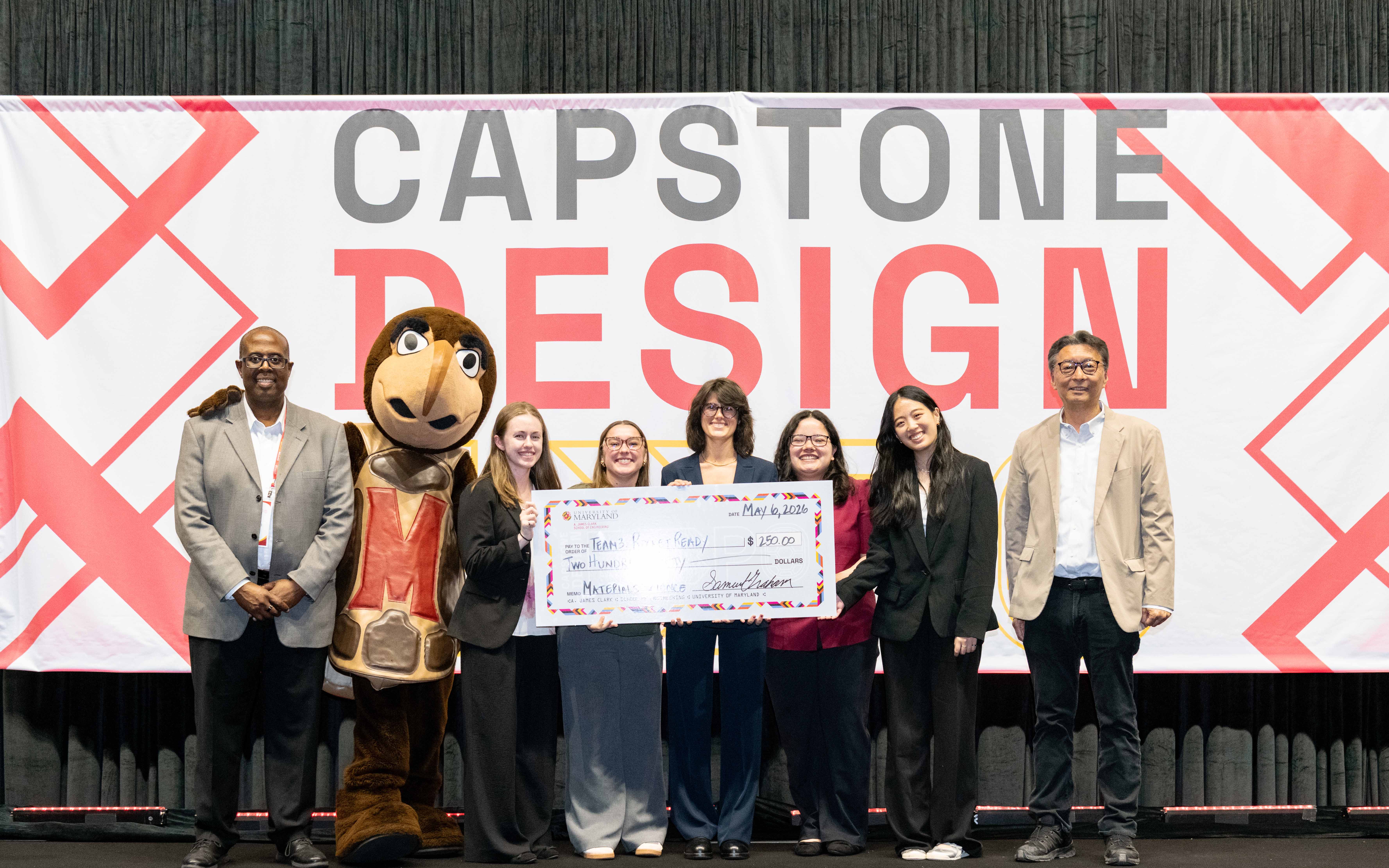
Group 1: "Glucose Biofuel Cell (G-BFC) Hybrid System for Pacemakers."
Watch Supplementary Video.
Group 2: "Plasma Functionalization for Improved EPDM–HTPB Interfacial Bonding."
Watch Supplementary Video.
Group 3: "Anti Stokes Laser Cooling for Electronics."
Group 1: "Chitosan Base Photoresist."
Group 2: "Microlaminated Metal Intermetallic Composite Armor."
Group 3: "Method for Electrostatic Dispersion of Nanoparticles in Polymer Coatings."
Group 1: "Novel PHB-CaSO4 Polymer Blend for Biodegradable Airsoft Pellets."
Watch Supplementary Video Here.
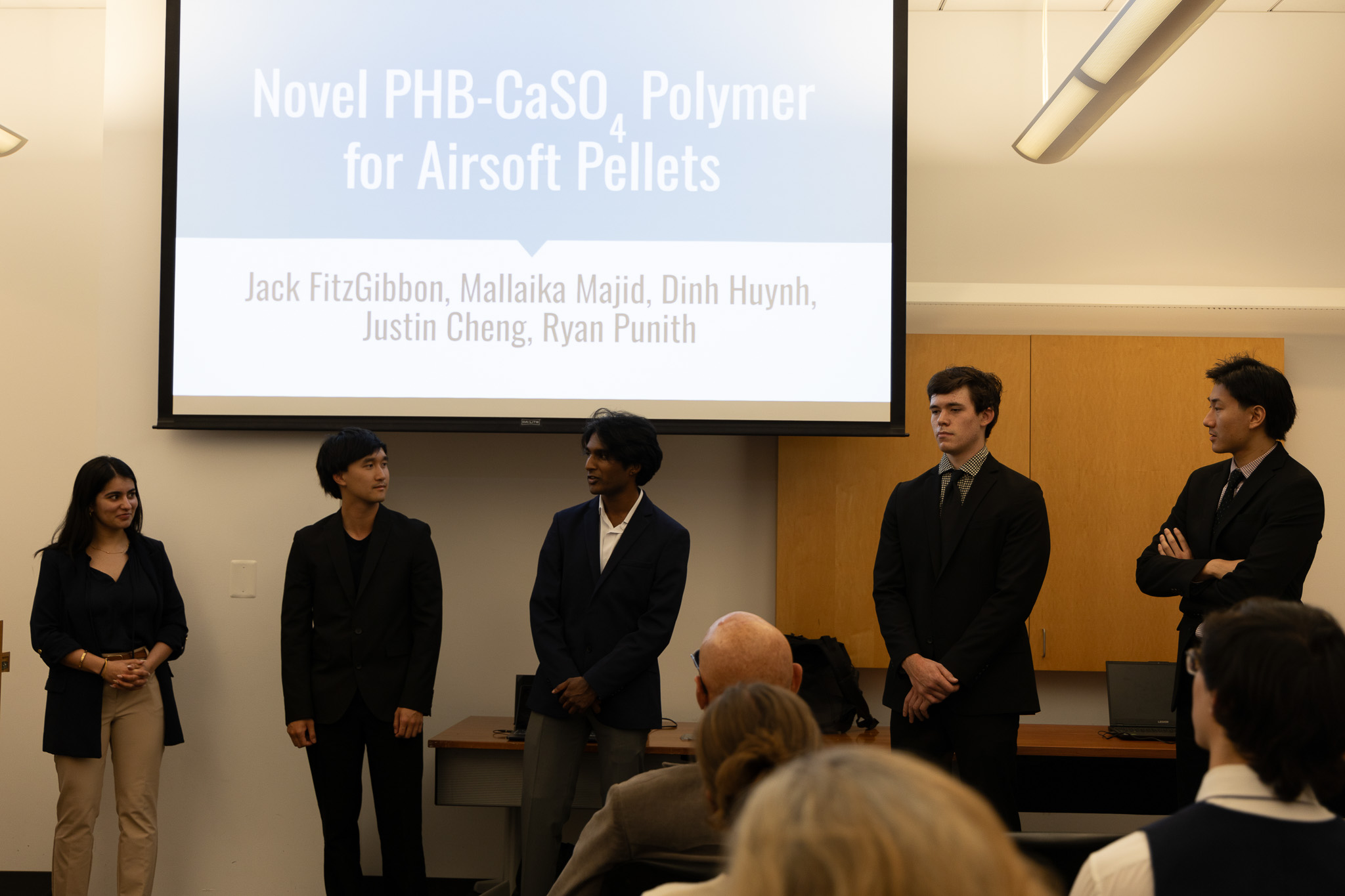
Group 2: "Plasmon Productions: Plasmon and PCM Based Matrix Multiplier."
Watch Supplementary Video Here.

Group 1: "Recycled HDPE-EVA Composite."
Watch Supplementary Video Here.
Group 2: "Piezoelectric Device for Energy Harvesting."
Watch Supplementary Video Here.
Group 3: "Autonomous Nucleation of Silver to Heal Surface Defects."
Watch Supplementary Video Here.
Group 4: "Functionalized Graphene Coating for Improved Tribological Properties of Ski Bases."
Watch Supplementary Video Here.
Spring 2022
Group 1: "3D Printing Programmable Materials with Complex Geometries."
Group 2: "An Investigation Into Various Methods for Filtering Arsenic Contamination From Water."
Group 3: "Bio-inspired Floorboard Design for Off-Road Vehicles to Resist Debris Puncture."
Group 4: "Synthesis of Ceramic-Polymer Composite Electrolytes and Spinel Trilayer Optimization for Lithium-Ion Batteries."
Spring 2021
Due to the covid-19 pandemic, capstone presentations were cancelled for this year.
Spring 2020
Group 1: "Polymer/Metal-Organic Framework Mixed-Matrix Membrane for the Photoelectric Reduction of CO2."
Group 2: "Thin Film Impressed Current Protection for Ferrous Metal."
Group 3: "Design of a Novel Nanocomposite for Stereolithographic Additive Manufacturing of Strain Sensors."
Group 4: "Solid-State Composite Electrolyte of SiO 2 /PEO/PTFE/NaClO 4 for Sodium Ion Batteries."
Group 5: "Adaptive Cooling Via Shape Memory Alloy."
Group 6: "Developing a pH-Sensitive Hydrogel for Agricultural Applications."
Spring 2019
Group 1: "Nylon Based Copolymers For Biodegradable Fishing Net Applications."
Group 2: "Daisy Chain Approach to the Study of Solid-State Battery Interfaces."
Group 3: "Additive Manufacturing of Compositionally Graded Ni-Cu Alloy System for Crack Detection and Propagation."
Spring 2018
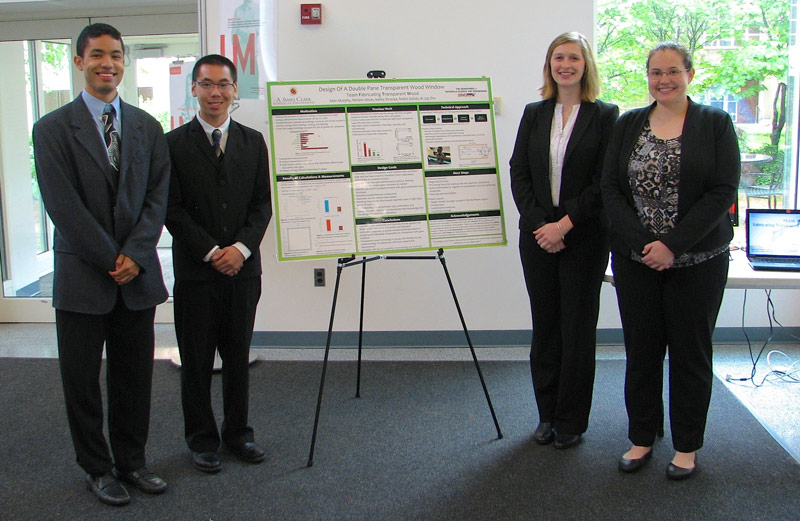
Group 1: "Design of a Double Pane Transparent Wood Window."
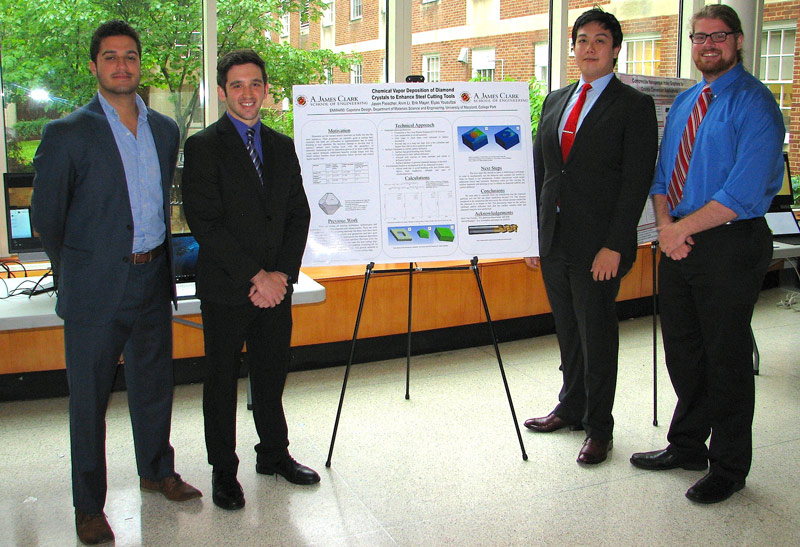
Group 2: "Enhanced Tool Steel with Chemical Vapor Deposition Diamond."
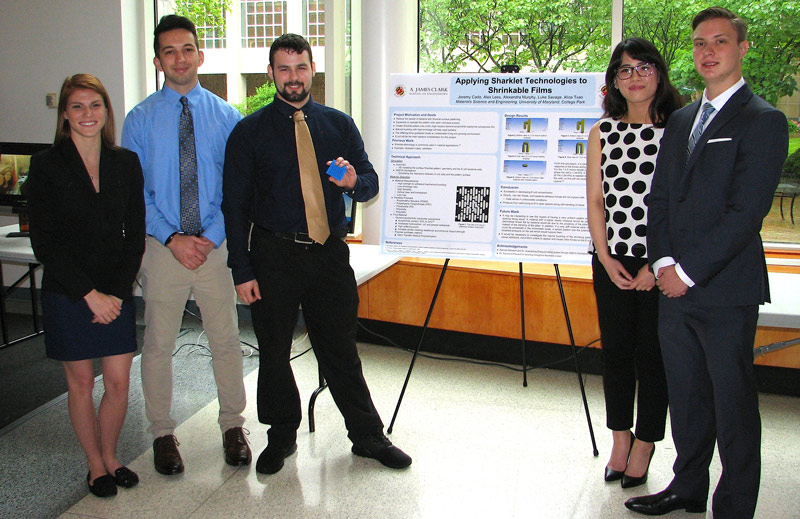
Group 3: "Applying Sharklet Technologies to Shrinkable Films."
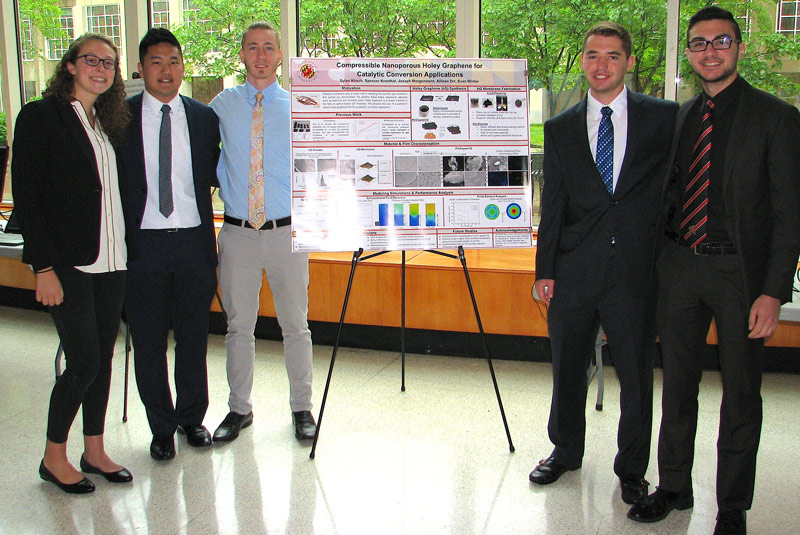
Group 4: "Compressible Nanoporous Holey Graphene for Catalytic Conversion Applications."
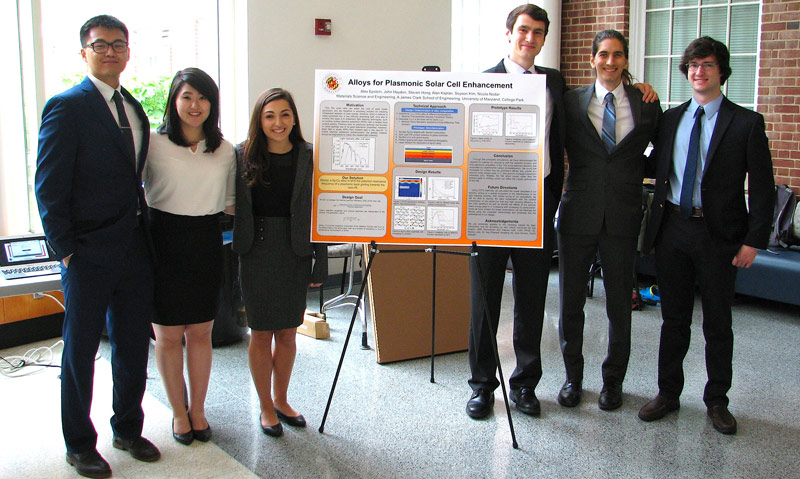
Group 5: "Ag-Cu Alloys for Plasmonic Solar Cell Enhancement."
Spring 2017
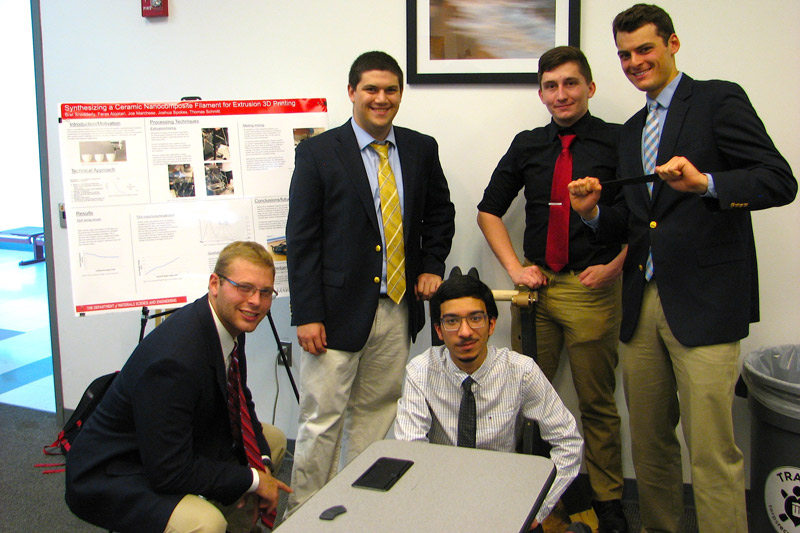
Group 1: "Synthesizing a Ceramic Nanocomposite Filament for Extrusion 3D Printing."
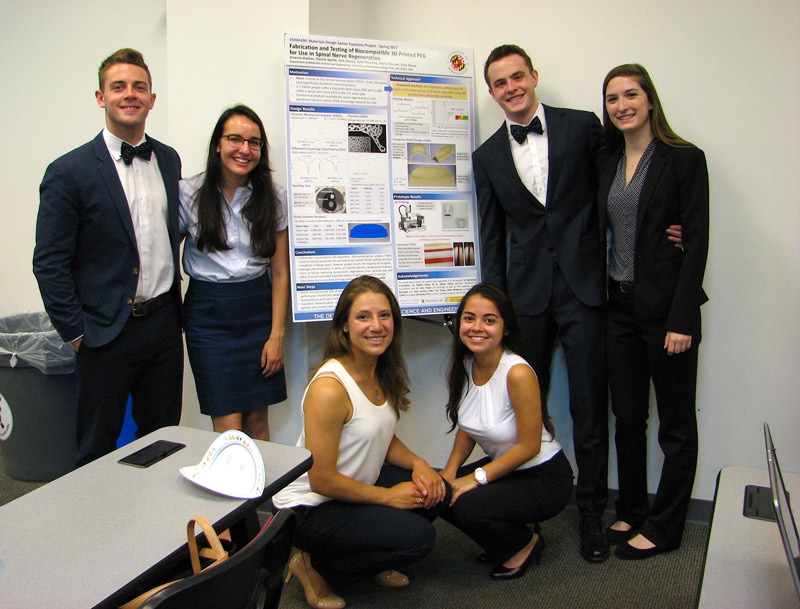
Group 2: "Fabrication and Testing of Biocompatible 3D Printed PEG for Use in Spinal Nerve Regeneration."
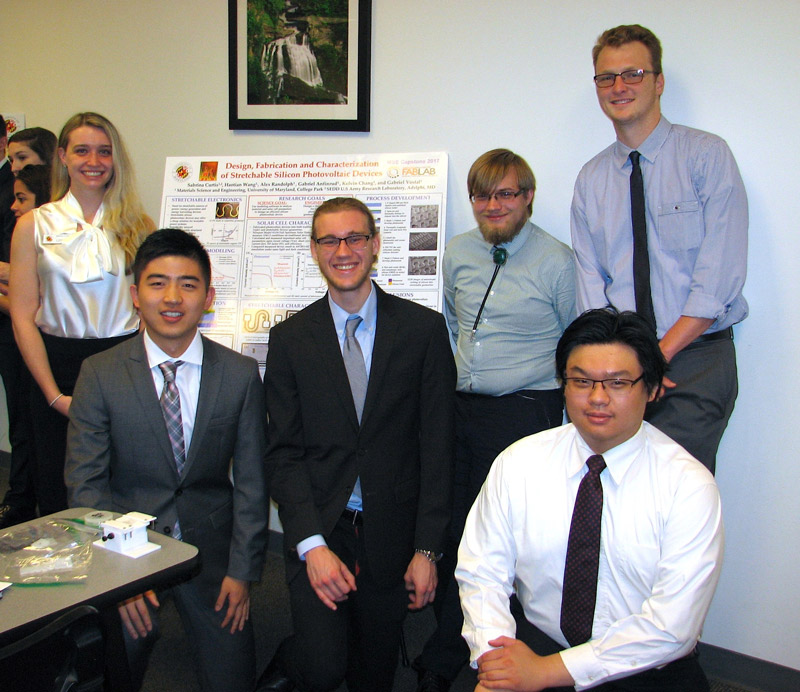
Group 3: "Design, Fabrication and Characterization of Stretchable Silicon Photovoltaic Devices."
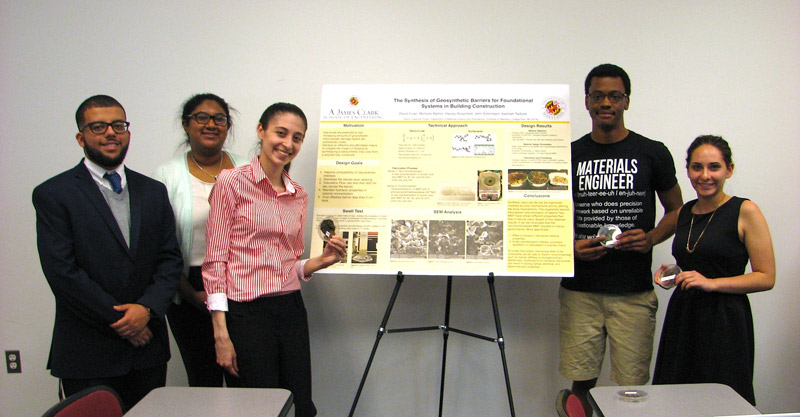
Group 4: "The Synthesis of Geosynthetic Barriers for Foundational Systems in Building Construction."
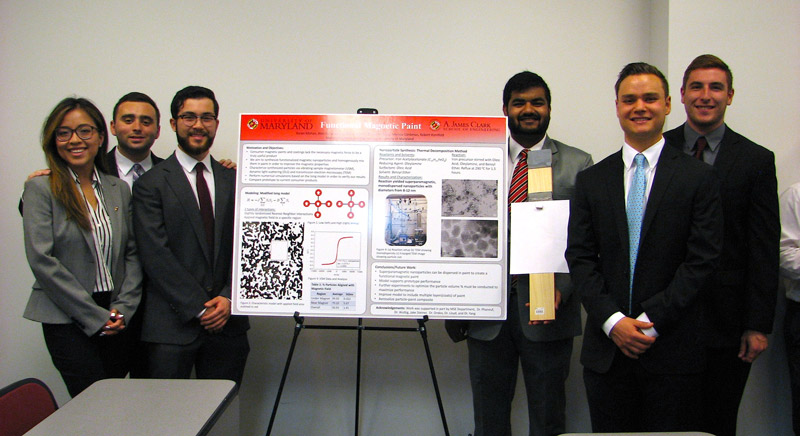
Group 5: "Functional Magnetic Paint."
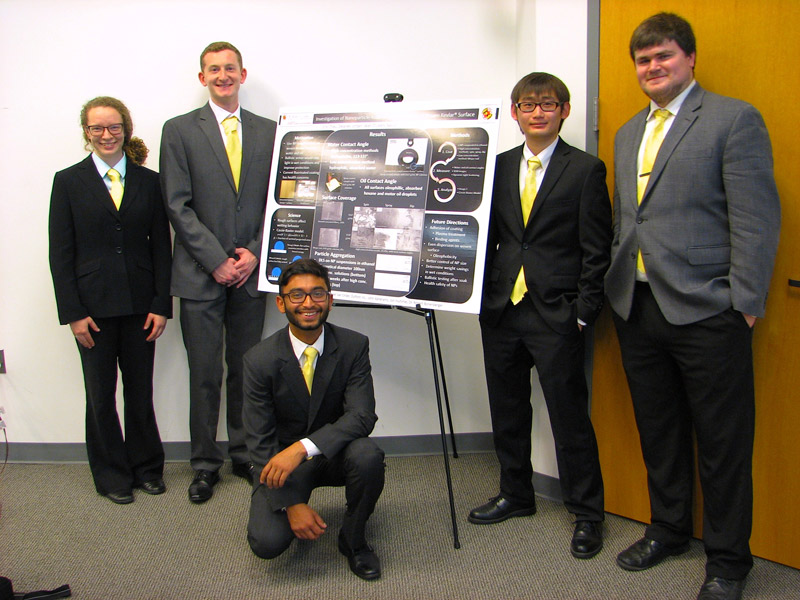
Group 6: "Investigation of Nanoparticals… Kevlar Surface."
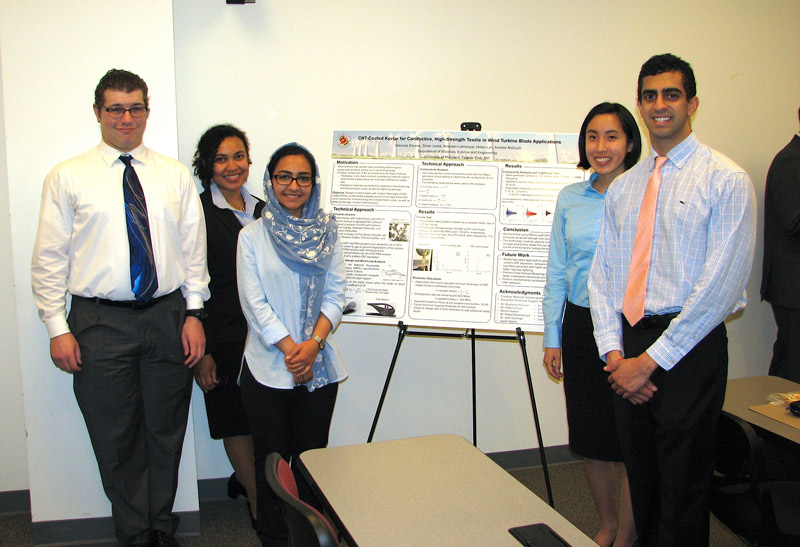
Group 7: "CNT-Coated Kevlar for Conductive, High-Strength Textile in Wind Turbine Blade Applications."
Spring 2016
Group 1: "Adipose-Tissue-Inspired Viscoelastic Composite for Tunable Soft Implant and Elastomer Applications."
Group 2: "Consumer-Applicable Retroreflective Microspheres for Use in Polyester Fabrics."
Group 3: "Infrared Antireflection Moth's Eye Nanostructures."
Group 4: "Radio Frequency Welding of Multi-Walled Carbon Nanotubes for Plastic Bonding."
Group 5: "Scalable Production of Nanofiber Filtration Membranes via Solutions Blow Spinning."
Group 6: "Sprayable Piezoresistive Strain Gauges."
Spring 2015
Group 1: "Fiber-Reinforced Carbon Aerogel for Insulation in Thermally Hostile Environments."
Watch supplementary video here.
Group 2: "Polyurethane-Graphene Laminar Composite as Transparent Armour." Watch supplementary video here.
Group 3: "Laser-Induced Porous Graphene Sponge for Oil Absorption."
Watch the supplementary video here.
Group 4: "Reduction of Nitrates From Runoff Water Via Absorbent Cellulose Matrix Embedded with Activated Carbon Black."
Watch supplementary video here.
Group 5: "Woven Bamboo Composites."
Watch supplementary video here.
Group 6: "Multi-Scale Study of Spark Plasma Sintered Graphene-SiC Ceramic Composites."
Watch supplementary video here.
Spring 2014
Group 1: "Enhancing Concrete Formulations for Additive Manufacturing."
Watch supplementary video here.
Group 2: "Incorporating Polymers to Reduce Cost of Smart Windows."
Watch supplementary video here.
Group 3: "Novel PBA-Grafted Carbon Nanotube Soft Body Armor."
Watch supplementary video here.
Group 4: "Sprayable Antibacterial Film: A Nanosilver Composite."
Watch supplementary video here.
Spring 2013
Group 1: "Biomedical Implant Corrosion Passivation Using PAMAM Dendrimer Films."
Watch supplementary video here.
Group 2: "Team Dramastic: "Designing An η-Cu6Sn5 Alloy Anode for Sodium Ion Batteries."
Watch supplementary video here.
Group 3: "Economical Photocatalytic Water Splitting Using ZnWO4 and NiOx Catalysts."
Watch supplementary video here.
Group 4: "Light-Activated Shape Memory Polymers (SMPs): Muscle Actuation for Prosthetics."
Watch supplementary video here.